

Cortagen Peptide
Research Profile, Mechanism, and Safety Overview.
Cortagen peptide has emerged as a quiet but increasingly discussed entry in the world of short regulatory peptides. While it doesn’t carry the name recognition of BPC-157 or Epitalon, its epigenetic mechanism of action and connection to the well-studied bioregulator Cortexin have made it a focal point for researchers investigating neuroprotection, oxidative stress, and cardiovascular gene expression.
This guide breaks down what Cortagen peptide is, how it’s theorized to work, what the available research shows, and where it currently stands from a regulatory standpoint.
What Is Cortagen peptide?
Cortagen is a synthetic tetrapeptide with the amino acid sequence Ala-Glu-Asp-Pro (AEDP). It was developed through amino acid analysis of Cortexin, a natural brain cortex peptide preparation, and belongs to the broader Khavinson peptide family — a group of short regulatory peptides, sometimes called cytomedins, that were originally characterized in Russian neurochemical research.
Unlike larger growth-factor peptides, Cortagen’s four-amino-acid structure places it in a category of “informational molecules” theorized to interact with gene regulatory machinery rather than triggering conventional receptor-mediated signaling cascades.
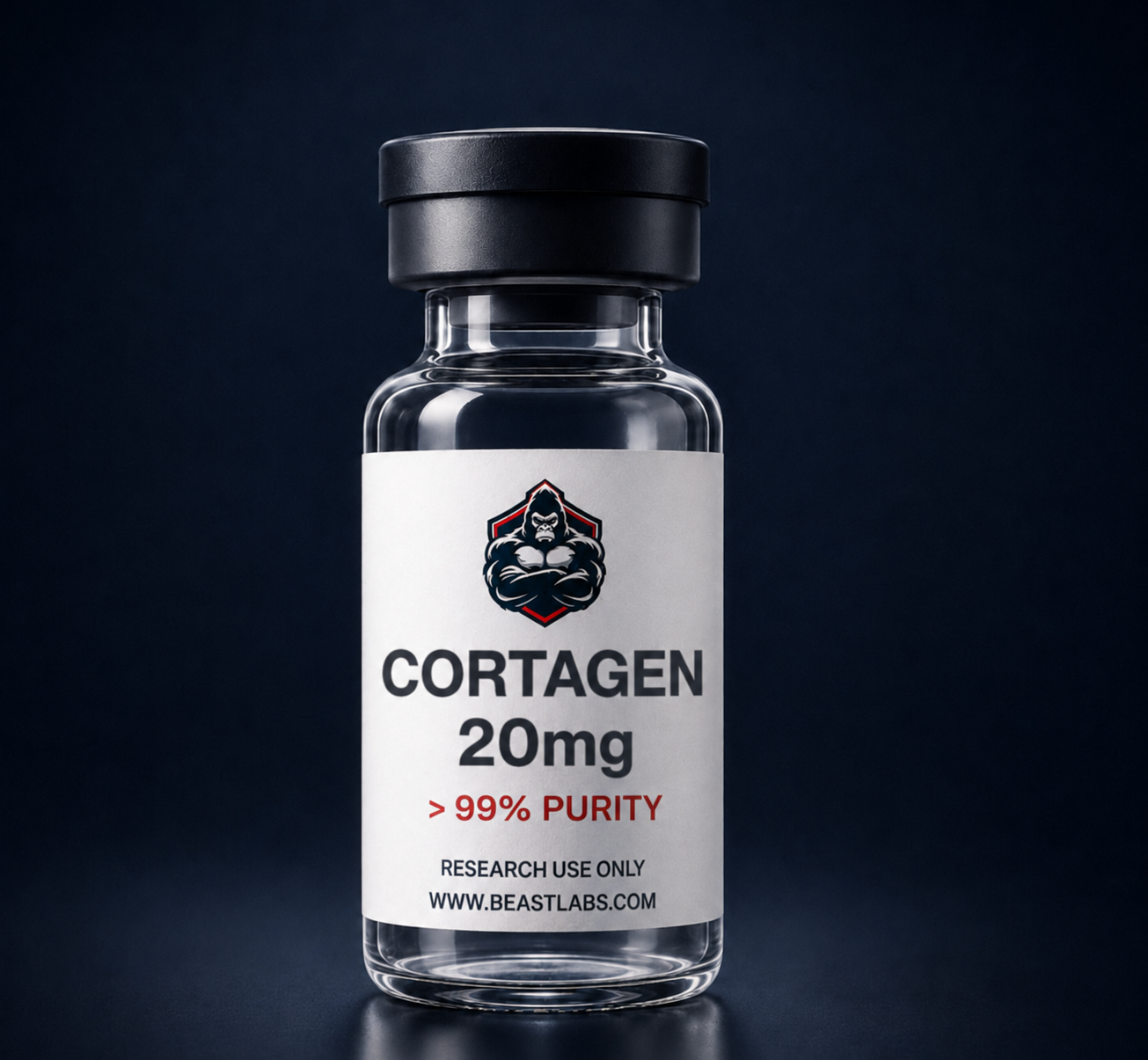
Cortagen — short-chain peptide bioregulator, 20mg per vial. For laboratory research use only. Not for human or veterinary use.
Each vial is sealed and traceable to a tested lot. Pair with bacteriostatic Diluent Solution for reconstitution.
Specifications
| Specification | Details |
|---|---|
| Purity (HPLC) | ≥99% |
| Identity | Confirmed (MS) |
| Form | Lyophilized powder |
| Endotoxin | < 0.5 EU/mg |
| Storage | Freeze, protect from light |
| Lot | BL-2406 |
Cortagen vs. Cortexin: What’s the Difference?
Cortexin is a natural polypeptide complex extracted from brain cortex tissue, containing a broad mixture of peptide fractions. Cortagen, by contrast, is a single synthetic tetrapeptide isolated and reproduced based on amino acid analysis of Cortexin’s active fractions. In short, Cortagen represents a more targeted, standardized synthetic approach to isolating one of Cortexin’s proposed active components.
Proposed Mechanism of Action.
Most nootropic and neuroprotective peptides act through neurotransmitter modulation or growth-factor receptor activation. Cortagen’s proposed mechanism is different.
Research on short Khavinson-family peptides suggests they may interact directly with chromatin structures, influencing the accessibility of specific gene regions and modulating transcriptional activity. If accurate, this would mean Cortagen doesn’t produce an immediate, short-lived signaling effect — instead, its influence on gene expression patterns could persist beyond the period of administration, distinguishing it mechanistically from most conventional research peptides.
This epigenetic hypothesis is central to why Cortagen is discussed in three main research contexts:
- Neuroprotection — supporting neuronal ATP regulation and buffering against lipid peroxidation in brain tissue
- Oxidative stress modulation — preserving antioxidant activity in neural tissue under stress conditions
- Cardiovascular gene expression — altering transcript expression patterns relevant to cardiac and cerebrovascular function
What Does the Research Show?
Nerve Regeneration Research
In preclinical work examining peripheral nerve injury, researchers transected sciatic nerve trunks, micro-sutured them, and studied conduction recovery in vitro using a multielectrode platform. Compared to placebo, Cortagen was associated with:
- A 27% increase in the length of nerve segment able to conduct impulses
- A 40% improvement in supported conduction velocity
Researchers interpreted these findings as a potential marker of more advanced functional maturation, possibly tied to improved myelination and fiber caliber — though the authors also noted the peptide appeared to preferentially support regeneration in cases where baseline growth was already lower, rather than extending growth beyond typical maximums.
Cardiac Gene Expression Research
Separate investigations have used microarray analysis to examine how Cortagen influences gene expression in cardiac tissue, building on earlier clinical observations that Cortagen treatment produced measurable effects on cardiovascular and cerebrovascular parameters — in addition to its documented role in posttraumatic peripheral nerve recovery. This line of research aims to map the transcriptional mechanisms behind those broader physiological effects, an area of particular interest to anti-aging and gerontology research given the role peptide bioregulators are theorized to play in correcting age-associated cellular changes.
Human-Observed Effects (Research Context)
Some published research references pronounced effects on structural and functional recovery of peripheral nerve tissue following injury, alongside secondary observations in cardiovascular and cerebrovascular parameters. These findings are frequently cited as the basis for continued interest in Cortagen’s broader neuroprotective and systemic potential.
Regulatory and Safety Status
Cortagen is classified as a research compound and is not approved by the FDA for human or veterinary use, diagnosis, treatment, cure, or prevention of any disease. It is distributed exclusively for laboratory and research purposes, and any use outside of a controlled research or clinical-trial setting falls outside its intended scope.
Given this status, individuals encountering Cortagen through research suppliers should treat published dosing figures, protocols, or “stacks” as research parameters rather than clinical guidance. Any consideration of Cortagen in a health context should be directed through a licensed physician or clinical research provider who can evaluate current trial data, sourcing standards, and individual health factors — rather than through self-directed protocols.
How Cortagen Compares to Other Research Peptides
| Peptide | Class | Primary Research Focus |
|---|---|---|
| Cortagen | Khavinson tetrapeptide | Neuroprotection, gene expression, nerve regeneration |
| Cortexin | Natural polypeptide complex | Broad neurotrophic support (parent compound) |
| Epitalon | Khavinson tetrapeptide | Pineal function, telomerase activity |
| Semax | Heptapeptide | Cognitive function, neurotrophic signaling |
| BPC-157 | Pentadecapeptide | Tissue repair, gut and musculoskeletal healing |
Cortagen’s chromatin-level mechanism sets it apart from receptor-driven peptides like Semax and BPC-157, positioning it closer to Epitalon within the epigenetic-regulator category of Khavinson bioregulators.
Frequently Asked Questions
Is Cortagen the same as Cortexin? No. Cortexin is a natural, multi-fraction polypeptide complex derived from brain cortex tissue. Cortagen is a single synthetic tetrapeptide (AEDP) isolated through amino acid analysis of Cortexin’s components.
Is Cortagen FDA-approved? No. Cortagen is not approved by the FDA for any human or veterinary use and is sold strictly for research purposes.
What is Cortagen’s mechanism of action? Cortagen is theorized to interact with chromatin structures, influencing gene accessibility and transcriptional activity — an epigenetic mechanism distinct from typical receptor-based neuropeptide signaling.
What has research shown about Cortagen and nerve regeneration? Preclinical studies on transected sciatic nerves found Cortagen improved nerve conduction length by 27% and conduction velocity by 40% compared to placebo.
Is Cortagen safe for human use? Safety in humans has not been established through FDA-regulated trials. Cortagen should only be considered within a licensed research or clinical-trial context, under provider supervision.
| vials | 1vial, 2vials, 3vials |
|---|

Reviews
There are no reviews yet.